


The Panels PHOTOGRAPHIC TACTILE WORKS aim to enable all visitors to access direct knowledge of the cultural heritage, through solutions specifically designed and tested to facilitate the aesthetic experience of users and encourage the enjoyment of the artistic heritage pictorial.
The exciting experience of also “seeing” through touch artistic works guided and inspired the design and shape of these panels, where we adopted original solutions developed through the fruit of the work and experience gained by our team over many years of work and experimentation on these issues.
I tactile panels proposed by CITISLAB are presented as an innovative solution in the long-standing search for methods and supports that can promote theaccessibility within museums and exhibition areas and offer opportunities for inclusiveness in the visit routes. In fact, our products do not specifically target users with special needs, but are by their very nature created for any type of visitor using easily understandable forms and language, in total adherence to the concepts of the Design for All.
The implementation of the panels of tactile photographic works within exhibition routes also facilitates the inclusivity of students with disabilities during school trips to discover the cultural heritage and educational visits by fostering class collaboration and constructive discussion among pupils. In addition, these tools, made available to teachers in schools of all grades, can become a useful support in the study of the history of art, architecture and drawing.
Tactile Tools for Accessible Art
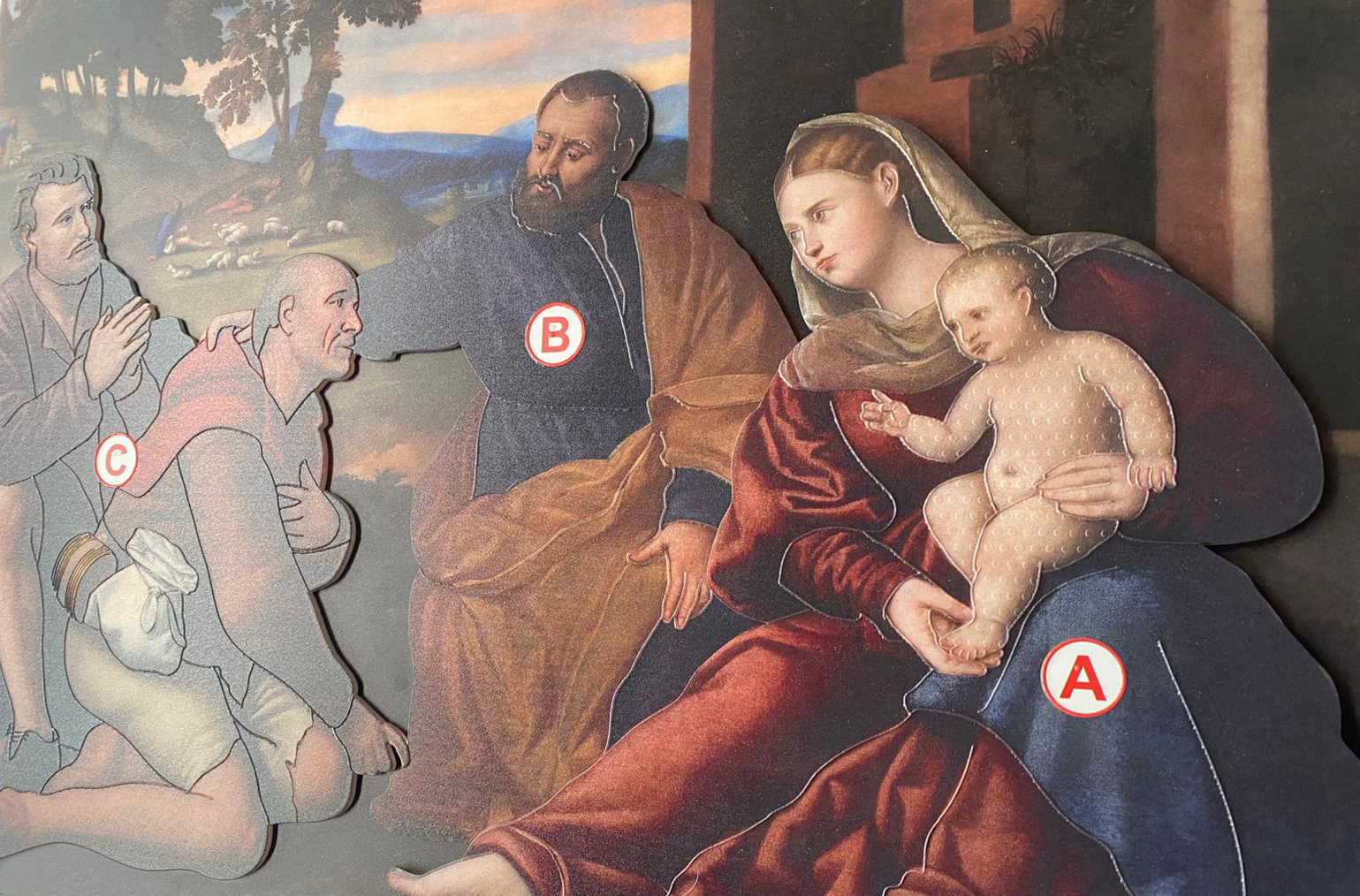
I PANELS OF PHOTOGRAPHIC TACTILE WORKS are the ideal tool for the tactile transposition of pictorial works through relief drawing and the technique of thick collage. This type of solution is particularly suitable for works of art that feature intricate compositions, characterized by the presence of numerous figures and/or elements positioned in a complex space. In these panels, unlike the panels of formal tactile works, the representation of the relief drawing rests on the color photographic reproduction of the pictorial composition.
The relief drawing ensures the accessible communication of the painting, allowing anyone to easily relate to works of art. Through touch-perceptible lines, dots, and textures, it is possible to represent and, therefore, understand and interpret even complex, three-dimensional objects/subjects in the same approach as reading a text with the hands through the Braille writing. The integration of the photographic reproduction of the work, also articulated in multiple layers of thickness suitable for communicating the mutual position and depth in space of figures and/or objects, provides an opportunity for visitors to appreciate details up close and can become an opportunity to facilitate the accessibility of the paintings especially when placed in poorly accessible places such as vault decorations or domes.


An Inclusive Experience for All
The tactile panels we propose possess all the characteristics dictated by the rules of good execution of the tiflological that make them effective and universally accessible the sign, such as: correct implementation of the reliefs and theBraille alphabet, preparation of simplified drawings but with non-superficial content, clarity in the contour lines of the figures, and respect for the proportions of the elements. In addition, these products comply with current laws and regulations regarding usability of places and overcoming and eliminating the architectural barriers.
In designing our tactile panels the challenge we set ourselves was to study an accessible language able to return, as far as possible, the narrative, emotion, specificities and values of the individual paintings. The preparation of the design of each panel is always preceded by the critical reading of the painting in question carried out in close collaboration with museum curators and art historians in order to identify those elements and/or figures that can effectively convey the symbologies and meaning of the work and which at the same time lend themselves most effectively to tactile communication.
Our panels exploit different relief heights to deconstruct the image into its main elements or planes of depth (foreground, foreground and background) rendered, in the case of PHOTOGRAPHIC TOUCH WORK PANELS, through elements of different thicknesses in relief on which is printed the photographic reproduction of the individual element (a figure or composition of figures, architecture, etc.). Elements in the foreground have a greater thickness than those in the background, while elements placed in the background plane, where they are present and interesting, are identified through backgrounds textured in relief transparent, so as to communicate their profiles and encumbrances allowing sighted people to read thephotographic image. The outlines and essential lines of the figures are described by means of transparent raised lines to allow for further detail of the images acquired by means of the touch, again without creating visual disturbance to the sighted. The panel is complemented by relief enlargement of some details ( focus) that, represented at the scale of the image, would be poorly tactile readable because they are too small. Their enlarged scale representation will allow their accessibility to blind or visually impaired visitors.

Through these panels any visitor, whether sighted or visually impaired whether blind, has the opportunity to investigate the individual parts of the picture by gradually reconstructing the image in its entirety; he can thus appreciate and grasp details that often escape initial analysis. The decomposition into levels is constituted, therefore, as a path guided reading of a cultural asset of pictorial type aimed at inclusively introducing visitors to the knowledge of the artistic heritage housed within a museum.
L’tactile exploration of the panels through a process of discovery and analysis by parts allows: to the blind person the progressive construction of the mental image of the drawing and to the sighted person the deepening of the global image acquired with the sight.