


Reading and feeling the landscape to make it tangible
Among the Microarchitectures proposed by Citislab, these solutions are basically installations to be inserted into the outdoor space, which can present themselves as very symbolic and evocative elements dropped into the landscape, or articulated in walls composed according to the “screen” concept, or constitute true small accessible volumes; they are always removable, however, and, if a charging service is provided, they are self-sufficient as they are powered by photovoltaics.
Here the main function is to bring the user into dialogue with the surrounding landscape, act as a visual bridge, tactile and more generally sensory between humans and the environment, and integrate this main experience with other functions, normally dispersed in so many objects in the space (seating, tabletop, device charging point, flower bed for greenery, and more depending on their complexity) always placing at the center of the installation the visuo-tactile panel intended for all users: this is for the purpose of providing one communication channel, the same for all, and also to maintain consistency with the emotional component.
CITISLAB proposes this type of installation where, as a complement to the visual-tactile panel, stimuli are to be offered that, instead of being conveyed only through sight as is always normally the case, are translated in a more engaging way.
When we look at a landscape, even one that we already know, we are often unable to perceive those elements that have made it unique and unrepeatable: transformations due to urban and territorial growth have produced stratified landscapes, where the overlapping of historical and contemporary elements does not allow the reading of the real value of architectural and natural elements.
Indeed, looking at any landscape we see a confusing system made up of housing, warehouses, road infrastructure, in which the most significant and symbolic parts such as monuments, natural reliefs, and historic villages are often hidden, overwhelmed by modern additions and therefore no longer perceptible.
Therefore, in order to discern these elements, it is necessary to discretize: subtract the disturbing elements and focus attention on the pre-existing values.
In particular, Readable Landscape Microarchitecture proposes visual-tactile readings of glimpses and pictures of landscape, thus allowing it to be read in its complexity through devices (framing, optical cones, ad hoc visual and relief representations, models, etc.) that interpret and enhance its history and specific morphological, environmental and architectural features.
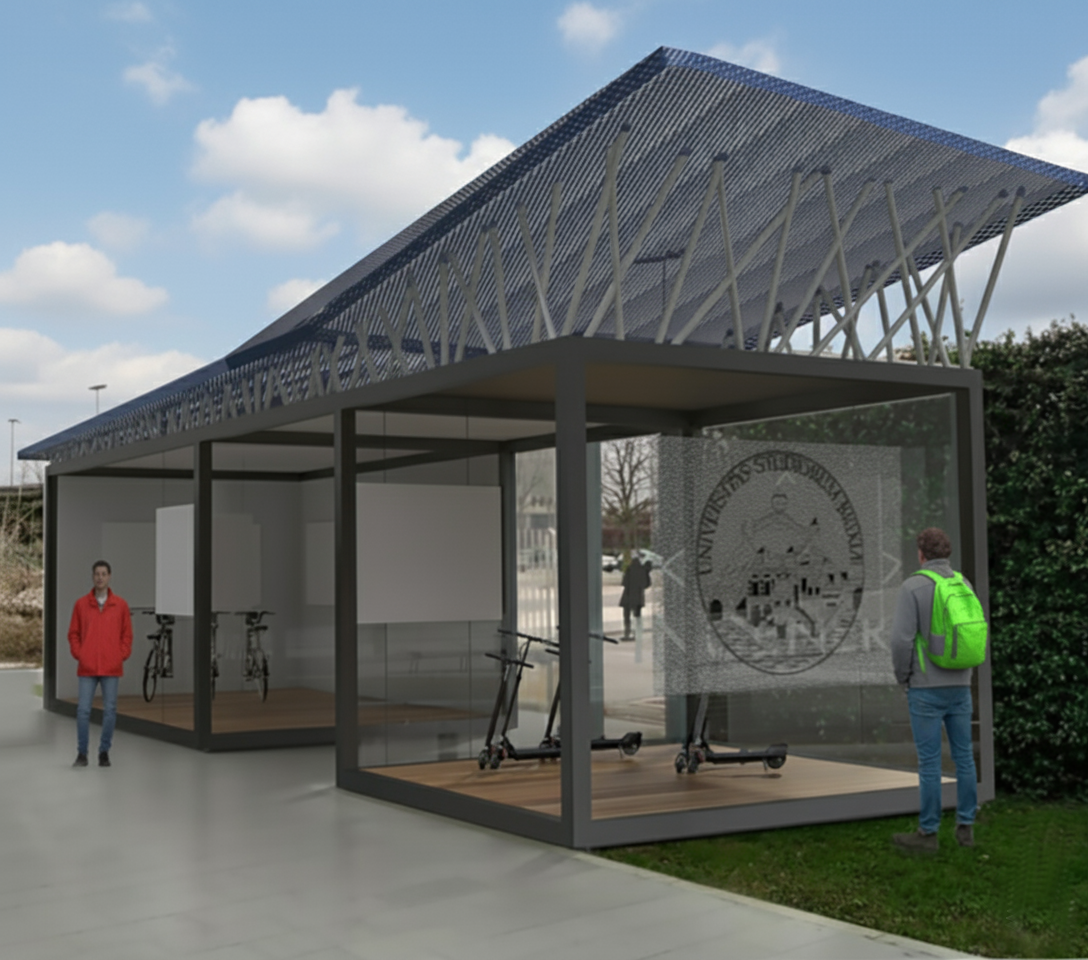
One proposed concept, the “Portal of Time,” functions as a telescope where visual data is combined with tactile data and consists of a transparent, permeable and non-invasive box-cabin topped by a shaped and perforated sheet metal, fixed or sliding to adjust the shade according to time and season.
The walls of this micro-architecture are declined in different possible materials and are shaped and appropriately perforated according to inspirations from the four elements Earth, Water, Fire, Air connected to the peculiarities of the surrounding area; they can orient the gaze by precluding the irrelevant parts.
The presence of Citislab’s proposed solutions such as a Tactile Landscape Panel or Urban Tactile Landscape Panel or Urban Tactile Table and other indications proposed through the Tactile Signs (https://citislab.it/realizzazioni-tattili/) will encourage and guide the user in the exploratory reading of the landscape; in addition, for a Perception for All, frames of various shapes and sizes will also be available for different types of users (wheelchair users, children, etc.).
The Legible Landscape Microarchitecture, which will have to be defined in detail in relation to the site in which it will be inserted, enters fully into the products for the Thematic Landscape and Urban Itineraries proposed by CITISLAB: it can be combined with the other Tactile Panels and Tactile Tables through the common thread of Technologies, to offer amultisensory experience, accompanying and supporting any user.

Citislab proposes an additional way of interpreting the landscape: the historical-architectural reading offered by the Legible Landscape installation is transformed into a more emotional and individualized reading in the Sensory Landscape micro-architecture solution of which we propose a concept, which again will have to be adapted and declined according to the peculiarities of the context.
This proposal consists of one or more modules in which you can learn about a landscape through the use of the senses by doing anexperiential activity.
Based on the assumption that a landscape is made up of sensations and materials, our cognitive approach to landscape is often limited to sight alone, while the use of the other senses is delegated to a specific or accompanying moment to the main perception.
For those with differently developed senses, however, a landscape is made up of sounds, smells, tastes, and materials with which it interacts.
The proposed microarchitecture intends to enhance sensory knowledge, proposing it even to those who do not usually use other modes of knowing their surroundings.
In an eco-sustainable, modular and adaptable structure, moments of sensory exploration of the area will be realized, both for those who are unable to perceive visual reality and for those who are not accustomed to the extensive use of the five senses.
The concept includes a structure based on standard modules that will be composed according to the needs of the client. The modules, made of site-specific materials or other materials (steel, aluminum) will contain sensory thematic inserts that can evoke smells of medicinal and decorative plants, “textures” of native materials (from the park and/or used in local architecture), sensations of local plants and crops; tactile panels will accompany the exploration.
As in Citislab’s other proposals, the entire system can be made self-contained with the installation of a roof organized with photovoltaic panels.
The Sensory Landscape Microarchitecture, which will have to be defined in detail in relation to the site in which it will be inserted, enters fully into the products to be installed in the Thematic Landscape Itinerary proposed by CITISLAB: it can be combined with the other Tactile Panels and Tactile Tables through the thread of Technologies, to offer an even more immersive experience.

In summary, CITISLAB’s Readable Landscape and Sensory Landscape Microarchitectures propose an innovative approach to traditional visual landscape reading.
Thus, they are original narrative, sensory and inclusive cultural installations , a stimulus to a new inclusive perception, a tool for upgrading and supporting visitation, and can be interesting solutions for those who are about to propose new cultural content structured according to tangible communication and rich in ethical meaning.