


Orienting oneself in architectural space becomes a sensory experience
If the architectural space should be affordable and welcoming to all, inclusive, safe and known, then it is crucial to ask how all possible categories of users imagine and perceive it.
The Panels TACTILE ARCHITECTURE by CITISLAB are the result of much thought and study, and aim to make the architectural space around us accessible through extensively researched and tested solutions to facilitate orientation andinclusiveness of users.
The experience of exploring a place you have never visited before, such as can be a museum or an exhibition space or a monumental building of the artistic heritage Italian heritage or a public service building, or even a monumental site, in the absence of landmarks could create disorientation even for a sighted person. The desire to provide tools that enable as many people as possible to have a fulfilling and satisfying experience guided and inspired the design and shape of these panels, adopting original solutions developed through the fruit of the work and experience gained by our team over many years of working on these issues.

The importance of accessibility to architectural space
I tactile panels proposed by CITISLAB are presented as an innovative solution in the long-standing search for methods and supports that can promote theaccessibility within public buildings, artifacts historical-artistic artifacts, museums and exhibition areas and provide opportunities for inclusiveness in the visit routes. Our products, in fact, do not specifically target users with special needs but are by their very nature born to address any type of visitor using forms and language that are easily understood and attractive to all.
I TACTILE ARCHITECTURE PANELS are the ideal tool for the tactile transposition of buildings and spaces architecture through drawing in relief of floor plans, elevations, sections and elements of special value. They are widely used to describe visitor routes within a monumental site, museum or exhibition center by highlighting through symbols and traces the places of interest in order to enable the orientation of visitors.

The relief design makes it possible to make accessible to all representation of the building, allowing anyone to easily relate to the space around them. Through lines, dots and textures perceptible by touch it is possible to represent and, therefore, understand and interpret even complex structures according to the same approach as reading a text with the hands via Braille writing.
Tactile architecture panels: a bridge between architectural space and visitors
The tactile panels that CITISLAB develops possess all the characteristics dictated by the rules of good execution of typhlological tools that make them effective and universally accessible the sign, such as: correct implementation of the reliefs and theBraille alphabet, preparation of simplified drawings but with non-superficial content, clarity in the contour lines of the figures, and respect for the proportions of the elements. In addition, the tactile panels we propose comply with the laws and regulations currently in force regarding the usability of places and the overcoming and elimination of architectural barriers.
In designing our tactile panels the challenge we set ourselves was to study an accessible language capable of rendering, as far as possible, the architectural reality that surrounds us in the most faithful and communicative way.
Particularly for this type of panel, it is important to respect the proportions between the parts and the correctness of the scale reduction of the drawing. The preparation of the drawing of each panel is always preceded by the preliminary acquisition of technical documentation related to the site or building of interest (drawings, surveys, etc.) necessary for simplified restitution for tactile exploration.
Our panels take advantage of different relief heights to tactilely render the organization planimetric of the rooms, the articulation of the elevations or the complexity of a section through simplified relief drawing.


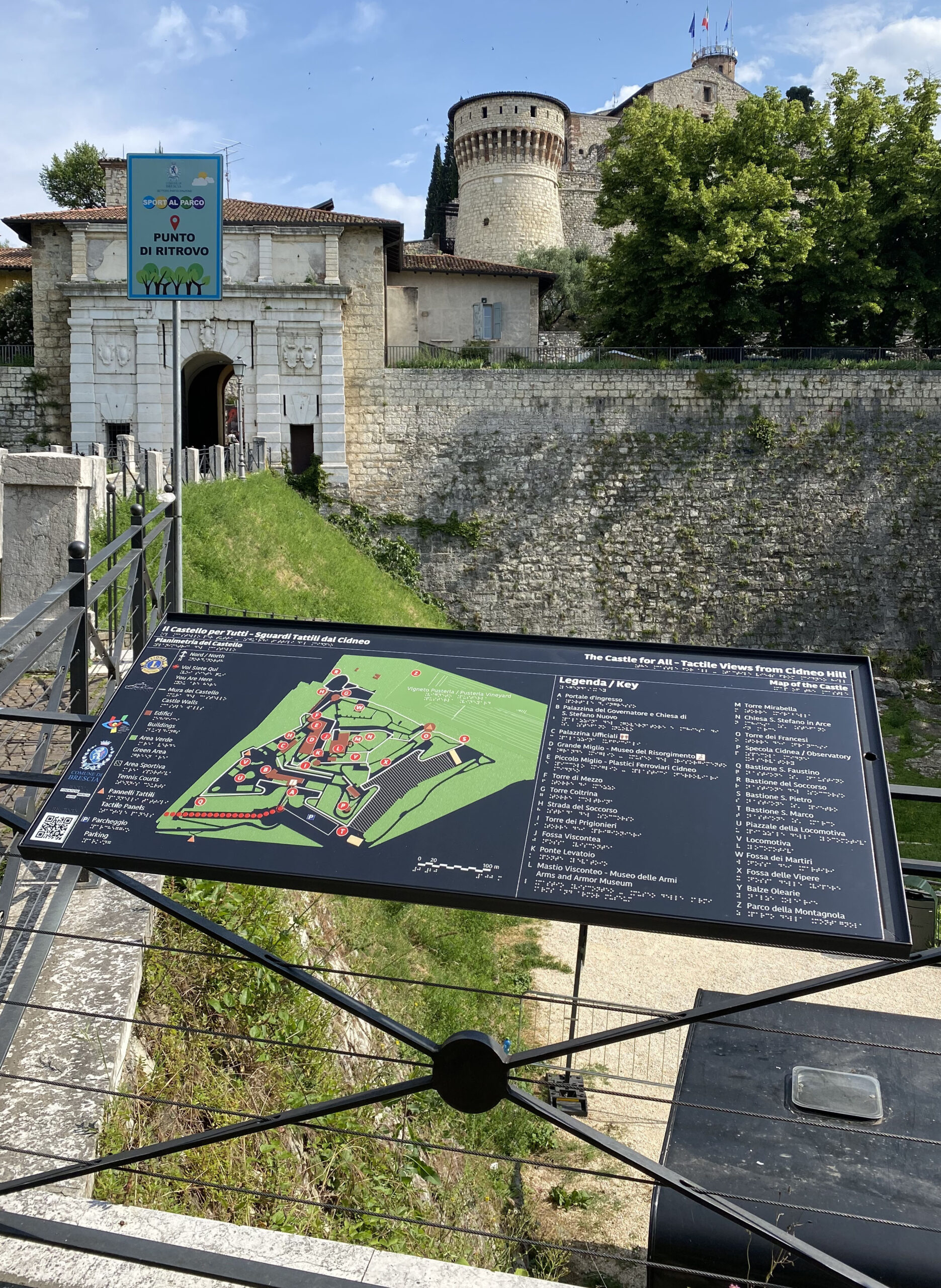
TACTILE ARCHITECTURE panels are, therefore, a valuable tool for knowledge, enabling visitors to understand and learn more about the architectural peculiarities of a site, museum or public building.
In the case of the museum, for example, the ability to clearly represent the thematic sections and layout of museum spaces makes them a particularly useful tool for planning and organizing a visit, providing a clear representation of the cultural itineraries and allowing customized routes to be planned autonomously and intuitively. They can help visitors to orient themselves in the space, easily identifying not only the works and rooms of interest, but also the essential services such as bathrooms, bookshop, stairs and elevators.
This feature significantly facilitates the visit, reducing the risk of disorientation and improving the overall experience. In addition, the tactile panels help optimize the flow management of visitors, effectively directing them through predetermined routes and distributing them in a balanced way within the exhibition spaces. In this way, the museum can ensure a more organized and harmonious fruition, avoiding overcrowding and ensuring a’ experience that is accessible and enjoyable for all.