


Research and experimentation for knowledge accessibility
In the university context, knowledge transfer is a key component in promoting economic development and social, civic and human values. Knowledge is often solicited from the territory in which the university is rooted, and is returned to the territory in the form of tangible or intangible products that are the result of research contracts.
Universities encourage the establishment of Spin offs, real entrepreneurial ventures that have reason to exist in order to realize products from research activities, with the aim of accessing the market.
Through Citislab, links can be strengthened between academic knowledge, expressed in research activities, and economic and social reality.
Citislab is the fruit of the research work university carried out since 2015 by Ivana Passamani on the themes of Tactile Communication and since 2014 by Olivia Longo on the topic of Microarchitectures.
Listed here in chronological sequence are past realizations that have enabled experimentation and arrived at real products, installed on the ground and used daily by the community. These realizations will be better described in the relevant in-depth pages.
Past Accomplishments-Visual Accessibility.
2020
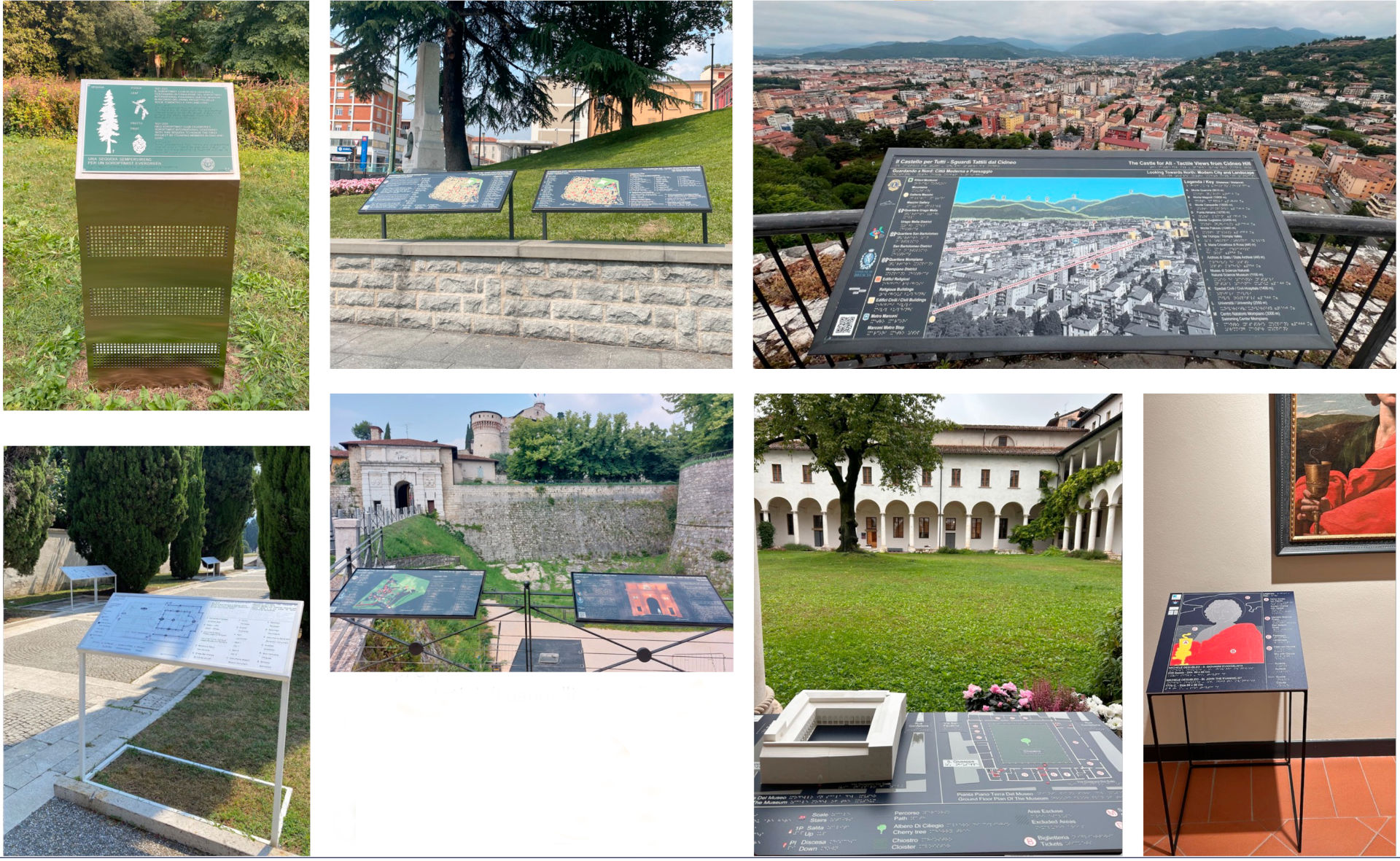
Project “A Sequoia sempervirens for an evergreen Soroptimist International” as part of the Celebratory Project announced by the National Union for the centenary of Soroptimist International 1921-2021.
The project by the Soroptimist International Club of Iseo included the planting of a redwood tree (Sequoia sempervirens), in memory of the first action taken more than a century ago by the U.S. founders of Soroptimist International who gathered in Oakland to save a redwood forest, gaining public support, flanked by a tactile panel explaining the project and the Sequoia, made for all users in dual Italian and English languages, with SI logo and short explanatory text.
The panel was designed by Ivana Passamani, as a member of Soroptimist Iseo.
2022-2023
Research contract “The City of Memory in the Capital of Culture: knowledge and enhancement of the Vantiniano Cemetery of Brescia” between the Municipality of Brescia – Administrative Coordination and Cemetery Services Sector and the Department of Civil Engineering, Architecture, Land, Environment and Mathematics (DICATAM) of the University of Brescia.
Scientific officer Ivana Passamani.
Subsequent to the research, survey and knowledge phase of the entire site, five cultural tour routes were designed and offered according to the criteria of accessibility for all through tactile panels.
Two additional tactile panels were designed for the entrances to the site.
Research participants: Olivia Longo and Virginia Sgobba.
2022-2025
Cultural Route” The Castle for All. Tactile gazes from the Cidneo,” initiated in 2022 by the Brescia Leonessa X Days Lions Club together with numerous Lions clubs and the Friends of the Cidneo Committee.
Concept and Scientific Coordination Ivana Passamani.
It was planned to create a path of knowledge of the Castle aimed at the blind and visually impaired but usable by all, with a view to adhering to the principles of Design for All, where through the installation of 7 tactile panels, experiences were proposed to get to know landscape views and the architecture of the Castle, read in its relationship with the city.
2024-2025
Research contract “Everything Makes Sense. Representation methodologies for museum and artwork accessibility” between the Diocesan Museum Foundation of Brescia and the Department of Civil Engineering, Architecture, Land, Environment and Mathematics (DICATAM) of the University of Brescia.
Scientific responsibility Ivana Passamani.
The study on the monumental complex that houses the Diocesan Museum allowed the elaboration of a documentation of the site from an architectural point of view, translated into 3 planimetric panels, 1 tactile table and 1 skyline panel. The visual-tactile narrative of 13 works housed in the museum was also prepared, translated into a coordinated system of tactile panels declined according to Design for All criteria.
Previous achievements-Microarchitecture
2019-2022
Lombardy Region’s Call HUB Research and Innovation. Call for strategic research, development and innovation projects aimed at strengthening Lombardy’s research and innovation ecosystems as hubs of international significance (in implementation of D.G.R. No. 727 OF NOVEMBER 5, 2018).
Three-year project of the University of Brescia “Infrastructure and Services for Sustainable and Resilient Mobility – MoSoRe” University of Brescia lead partner, scientific referee: Prof. Giovanni Plizzari. The Departments of Civil Engineering, Architecture, Land, Environment and Mathematics; Economics and Management; Information Engineering; and Clinical and Experimental Sciences were involved.
Scientific responsibility Olivia Longo, Ivana Passamani
Research group under Action A5: “User service infrastructure for sustainable mobility,” for architectural and urban design of microarchitectures.

Past Accomplishments-Multisensoriality.
2017-2018
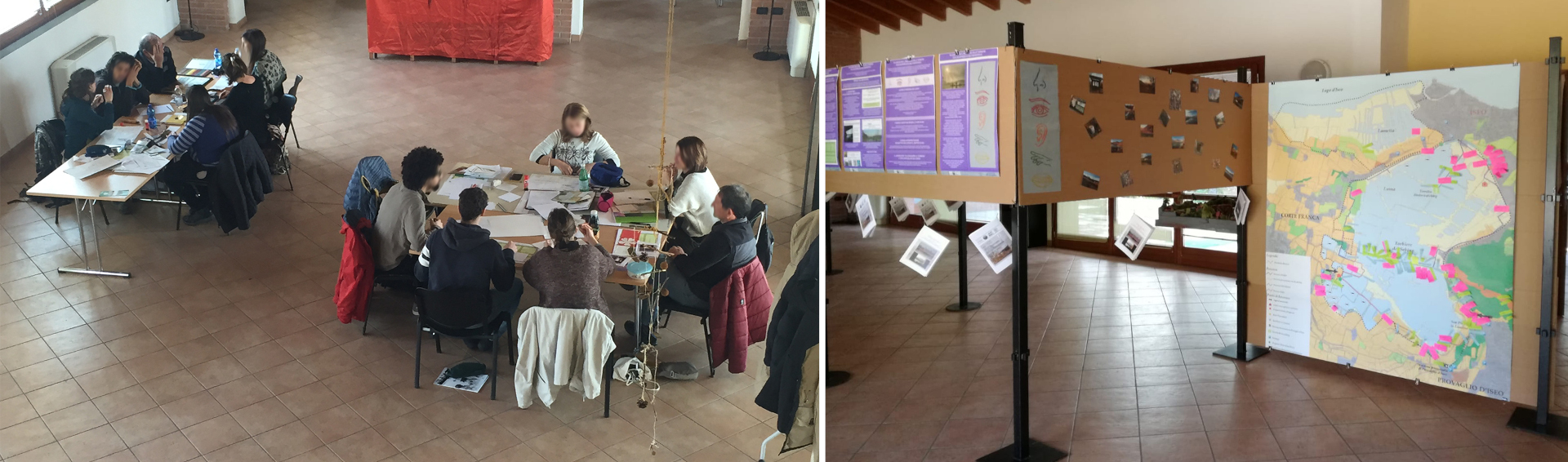
Cariplo Calls for Proposals 2016“I like Peatlands” project. “Re-knowing the peatland landscape” research laboratory project.
Scientific responsibility Olivia Longo, Ivana Passamani
Project funded by Cariplo “I like Torbiere”. Coordination Entity for the management of the Torbiere del Sebino nature reserve in Network agreement with the University of Brescia.
Partners: UNIBS, Province of Brescia, innovation and municipal services area, Franciacorta Foundation, Natura Life Association and others
Activities: Laboratory with lectures and workshops. Closing exhibition.
The key to understanding the landscape of the Peatlands was entirely set on multi-sensoriality.
2002-2004
Cultural route project “Discovering the King Vase, along the tale drawn by water,” Municipality of Bienno (Bs)
Scientific Coordination Ivana Passamani – Project Ivana Passamani, Lucia Morandini
The project proposed the preparation and implementation of a cultural and educational route along the “Vaso Re” in the municipality of Bienno, with the aim of enhancing this artificial canal derived in ancient times from the Grigna stream, implementing its transformation into an integrated museum system. The visit proposal has been integrally declined as a multisensory experience.
