


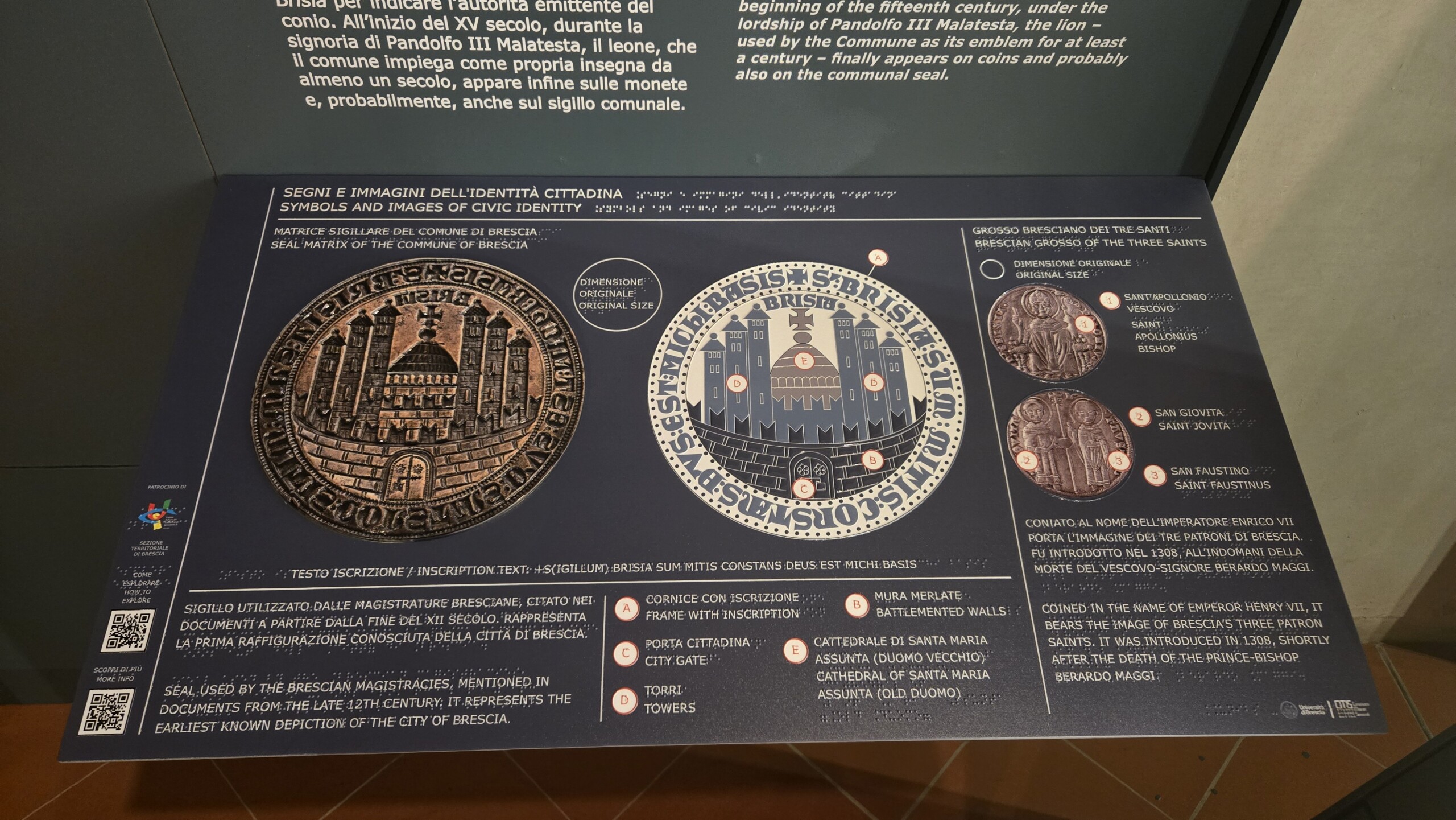
At the Santa Giulia Museum, there is a visual-tactile display panel featuring the seal of the City of Brescia and the “Grosso dei tre santi.”
In 2026, Citislab created a visual-tactile panel for the Santa Giulia Museum in Brescia, dedicated to the city’s seal matrix and the Brescian “Grosso” of the Three Saints. The panel is part of the permanent exhibition “Signs and Images of City Identity,” sponsored by the City of Brescia and the Brescia Museums Foundation and inaugurated on September 24, 2026.
Brescia: A Tactile Journey
The “Symbols and Images of Civic Identity” section is located in the area of the Santa Giulia Museum dedicated to the Age of the Commune and the Signorie. It displays the oldest seal matrix of the City of Brescia, which bears the earliest known view of the city, along with a selection of coins minted by the city’s mint. The die is on display at the museum thanks to a long-term loan from a Brescia-based collector. Non-invasive diagnostic tests conducted by the University of Milan and the CNR-ICCOM in Pisa have revealed that it is made of brass, which gives the object a hue similar to that of gold.
The seal and the coin were the means by which the municipality, even before the Peace of Constance, asserted its autonomy and shaped its image. On the coins minted there, the community identified itself through the name “Brisia,” its patron saints, and Bishop Apollonio.
Why use a visual-tactile panel for objects that are only a few centimeters in size?
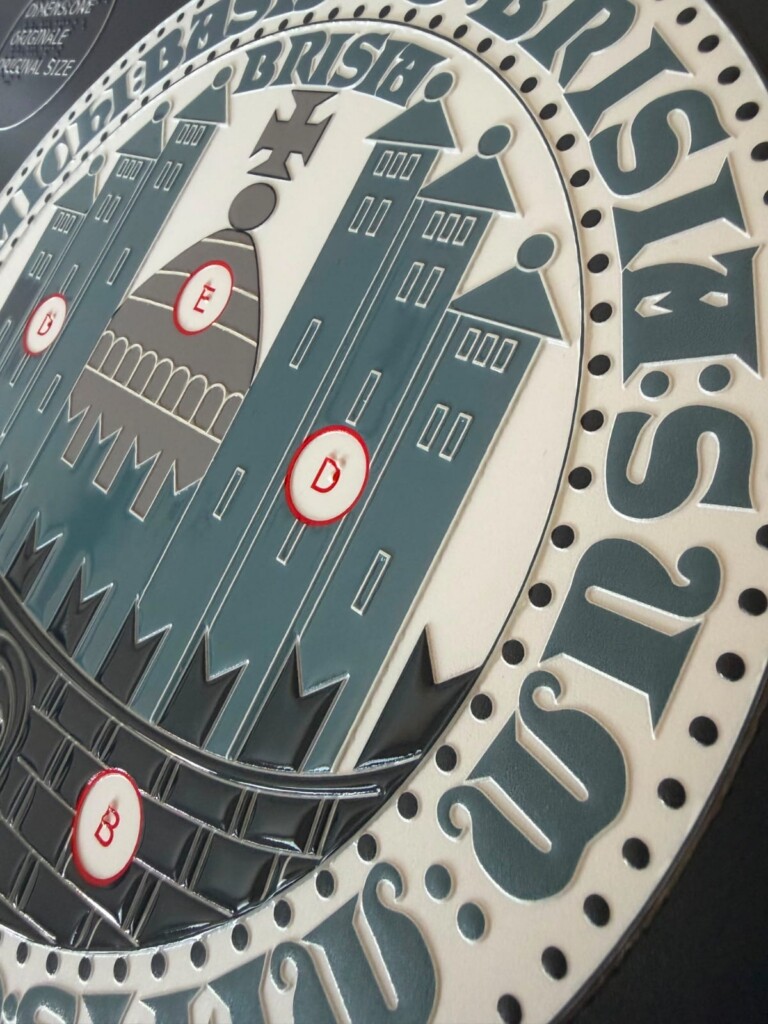
A visual-tactile panel makes very small objects legible both visually and by touch: the original seal matrix measures about 7.5 centimeters in diameter, while the “Grosso” measures about 2 centimeters. For this reason, the Citislab project focused on two key aspects: a change in scale, which makes the details perceptible to the touch, and the deconstruction of the image into its essential elements.
The approach follows the principles of Design for All. The panel makes the exhibition accessible to people with visual impairments, but it is intended for all visitors, since reading with the eyes and reading with the hands go hand in hand and complement each other. The tactile representation of these symbols broadens the audience that can understand them, based on the belief that knowledge of cultural heritage is a right for everyone.
What the Visual-Tactile Panel Is Like: Structure and Content
The visual-tactile panel is horizontal in orientation and measures 90 x 50 centimeters. It is divided into two main sections, separated by raised lines that facilitate tactile reading and guide the visitor’s hand from one section to the next.
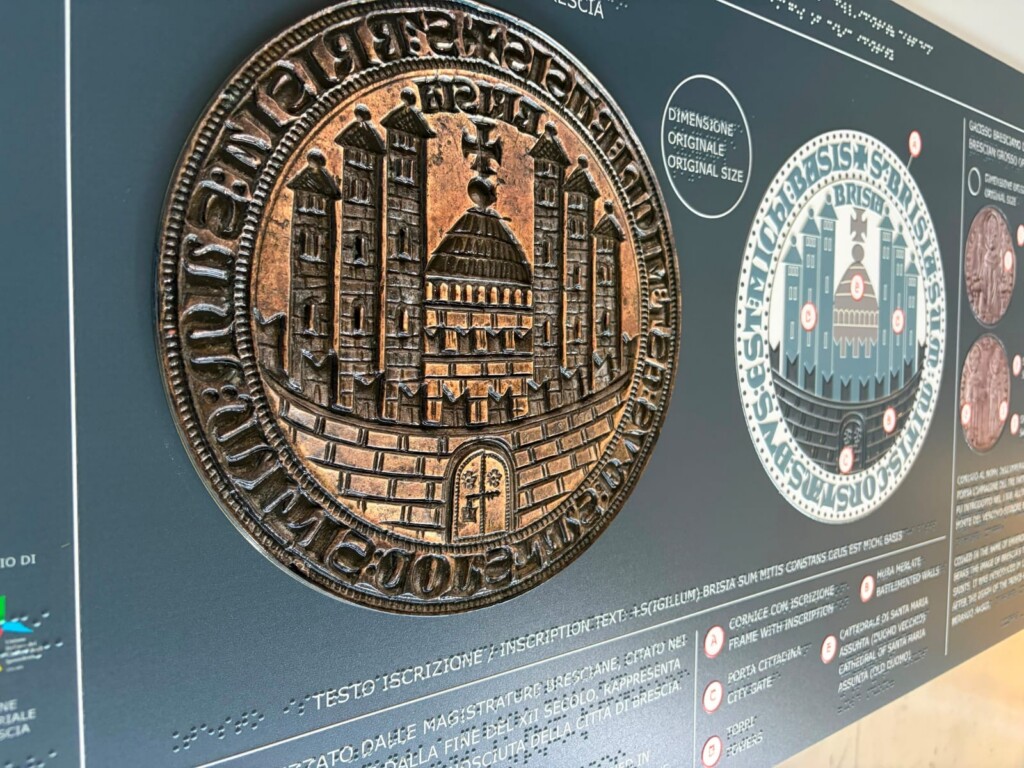
The Seal Matrix: 3D Reproduction and Mirrored Bas-Relief
The central, wider section features two visual-tactile representations of the seal matrix. On the left, the 3D reproduction allows visitors to appreciate its volume and texture, bringing them closer to the actual object. On the right, a mirror-image tactile bas-relief reproduces the engraved design: the crenellated walls with the six towers and the outline of the Cathedral of Santa Maria, now known as the Duomo Vecchio. Running along the edge is the Latin inscription that frames the view: + S(IGILLUM) BRISIA SUM MITIS CONSTANS DEUS EST MICHI BASIS, which translates to “I am Brescia, gentle and steadfast; God is my foundation.” In the panel, the original design is reproduced approximately four times larger than the original to facilitate an easy understanding of the details through touch.
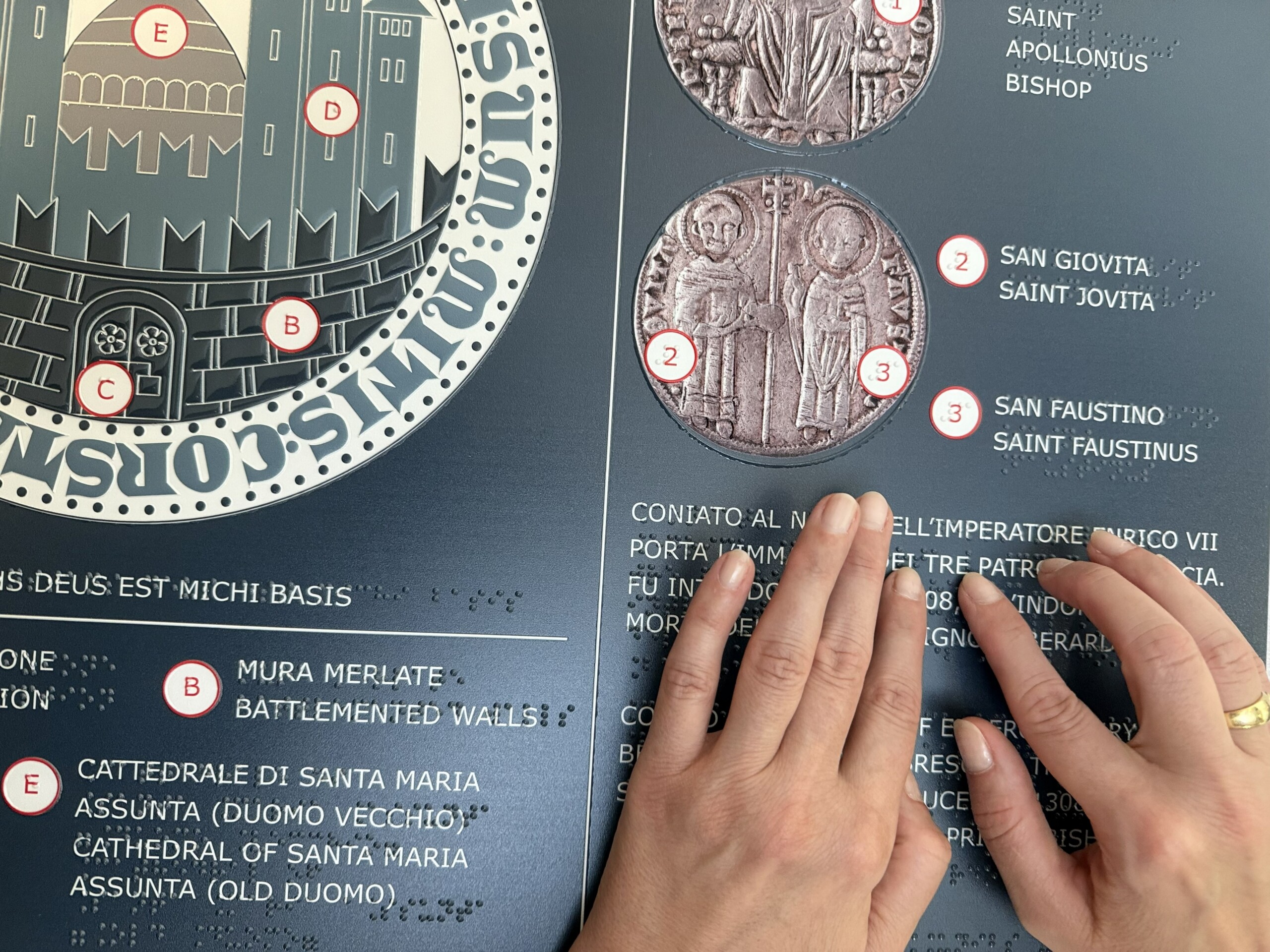
The “Grosso Bresciano” of the Three Saints
The right-hand side panel is dedicated to the “Grosso bresciano dei tre santi,” one of the oldest coins minted by the Brescia Mint. The panel displays the relief design of the obverse and reverse and highlights the figures depicted: Apollonio, the city’s first bishop, and the patron saints Faustino and Giovita. The coin, which is about 2 centimeters in diameter, is reproduced five times larger. The figures are made legible through varying thicknesses, in keeping with the image-deconstruction method that characterizes Citislab’s tactile panels.
Audio description via QR code
In the lower left corner, two QR codes enhance the exploration experience with audio descriptions. The first, “How to Explore,” links to an audio track that describes the panel and accompanies the tactile reading. The second, “Learn More,” offers in-depth content about the matrix and the coin.
Scientific and Institutional Partners of the Project
This section is sponsored by the City of Brescia and the Brescia Museums Foundation, with scholarly input from Matteo Ferrari (École des Hautes Études, Paris) and under the patronage of the Brescia chapter of the Italian Union of the Blind and Visually Impaired (UICI). The exhibition design is supported by arKStudio, which donated the design. The panel is part of the work of Citislab SRL, a spin-off of the University of Brescia, which has been working for years tomake cultural content accessible in a way that transcends the distinction between communication “for everyone” and communication “for some.” A report on the day’s events can be found in the news article about the panel’s inauguration at Santa Giulia.