University of Brescia research for the Brescia Diocesan Museum.
The research contract “Everything Makes Sense. Representation methodologies for museum and artwork accessibility” between the Diocesan Museum Foundation of Brescia and the Department of Civil Engineering, Architecture, Land, Environment and Mathematics (DICATAM) of theUniversity of Brescia was initiated in 2024 under the scientific responsibility of Ivana Passamani.
Initially, a study was carried out on the monumental complex that houses the Diocesan Museum: this made it possible to elaborate a documentation of the site from an architectural point of view and mainly from a formal and distributive point of view, translated into two tactile panels showing the floor plans of the two levels (+1 and -1), while for the ground floor plan a tactile table with the 3D model, much appreciated by visitors. Due to its location embedded in the dense urban fabric, a tactile visual panel of skyline.
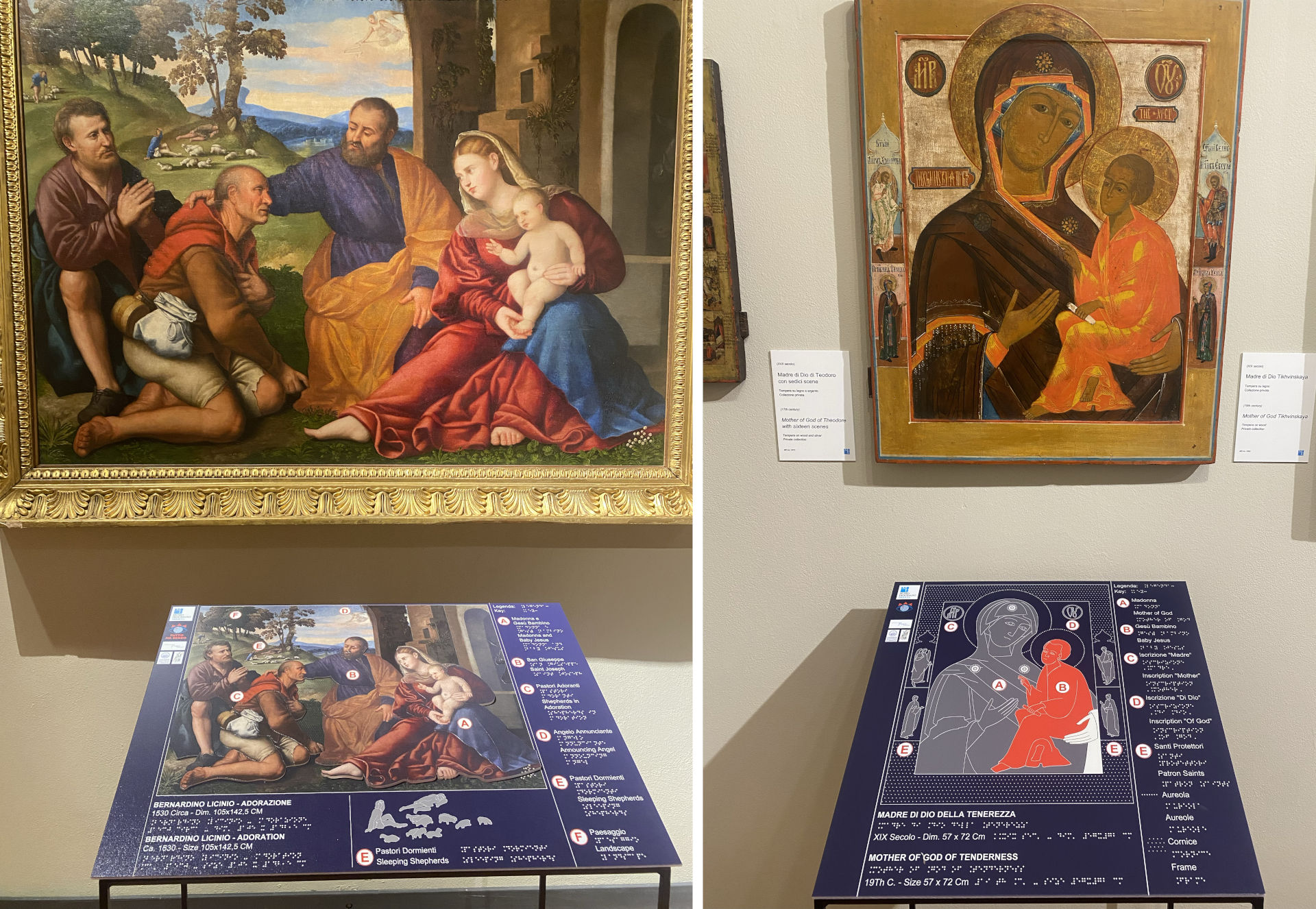
As for the artistic contents, we proceeded with the visual-tactile narration of thirteen works housed in the museum, translated into a coordinated system of tactile panels declined according to the criteria of the Design for All.
The intent was to create panels that manage to communicate, as much as possible, the narrative, emotion, specifics and values of the paintings.
Preliminary critical readings of each canvas have made it possible to identify elements or figures that convey the deeper meaning of the work.
The analysis of the paintings led to the identification of two types of tactile representation: the first applies the photographic decomposition of the scene elements, the second uses the formal decomposition.
In both, the method identifies in the image of the painting the levels of spatial depth (foreground, background and background) and associates a different thickness in relief to each level: even in a two-dimensional representation, the idea of depth and position of figures and elements in pictorial space is thus restored.