Focus some urban functions around inclusive communication
The three-year project (2019-2022) of the University of Brescia “Infrastructure and Services for Sustainable and Resilient Mobility – MoSoRe” which was led by theUniversity of Brescia responded to the Call for Proposals of the Lombardy Region “Call HUB Research and Innovation.”
This was a Call for strategic research, development and innovation projects aimed at strengthening Lombard research and innovation ecosystems as hubs of international significance (in implementation of D.G.R. No. 727 of 5/11/2018). The scientific contact person for the UNIBS project was Prof. Giovanni Plizzari. The Departments of Civil Engineering, Architecture, Land, Environment and Mathematics; Economics and Management; Information Engineering; and Clinical and Experimental Sciences were involved.
The research group under Action A5: “User service infrastructure for sustainable mobility,” for the architectural and urban design of microarchitectures had Olivia Longo and Ivana Passamani as scientific leaders. Virginia Sgobba and Davide Sigurtà were members of the research team.

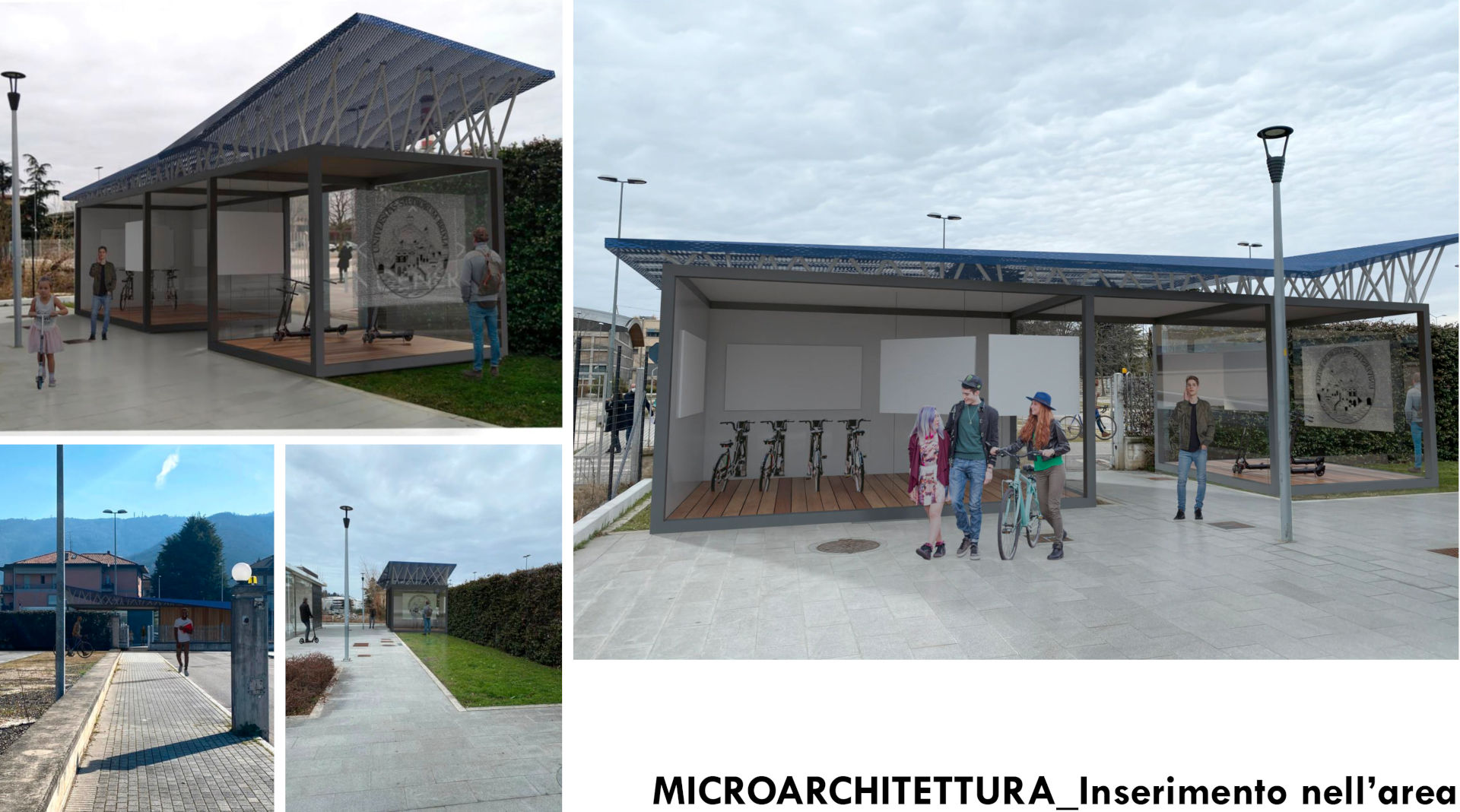
The project involved the construction of two charging stations for bicycles and scooters, placed the first in Viale Europa next to the Metro Europa station, near the University Campus in Brescia; the second in Bassano Bresciano (Bs). These two infrastructures, powered by photovoltaic panels, pose as connecting hubs between different types of urban mobility, becoming landmarks for crossing the territory by sustainable means of transport.
Attention has been paid to the analysis of the context for the knowledge of the dynamics related to mobility but also to culturally connect the new buildings with the relevant area.
The connection was made explicit in the microarchitecture of Brescia through the design of two cultural routes of discovery of the surrounding area, proposed both graphically and technologically: scanning the QR Code opens the cards of the points of interest along the two suggested routes.
The first, “Route in Landscape,” leads to the rediscovery of the territory of the ancient municipality of San Bartolomeo. The second, “Route in Architecture,” traverses the territory of Mompiano.
The points of interest identified were organized into five themes: Signs of Water, Signs of Living, Signs of Work, Signs of Landscape, and Signs of Religiosity.
This project resulted in a Microarchitecture prototype that encompasses several functions within it.